If you built a checklist for what a Winter Olympic ski jumper is supposed to look like, Eddie “The Eagle” Edwards would miss almost every box.
-
Access to elite training facilities? Nope.
-
Decades of national investment? Not even close.
-
Perfect vision? Not remotely.
-
A nation expecting medals? Absolutely not.
Yet, Eddie Edwards became one of the most famous Winter Olympians of all time, not because he won medals—but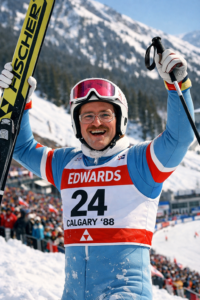 because he showed up, launched himself off a ski jump at terrifying speeds, and did it all with a grin that said, “Well… this should be interesting.” In the process he became both a fan and media favorite.
More than three decades later, Eddie the Eagle remains one of the most inspiring Winter Olympic stories ever told. Not because he was the best—but because he redefined what it meant to compete. His story endures to this day, even becoming a hit movie in 2016 starring Taron Egerton and Hugh Jackman.
Still, the real tale is just as unbelievable as Hollywood… if not even more so. This is the true story of Eddie “The Eagle” Edwards: his early life, his unconventional path to the Olympics, how he qualified against all odds, and why his legacy still matters in Olympic history today.
Who Is Eddie “The Eagle” Edwards?
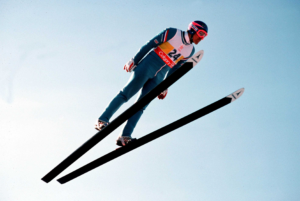 Michael “Eddie” Edwards was born on October 5, 1963, in Cheltenham, England—a place better known for horse racing and quiet countryside living than producing Olympic ski jumpers. But, young Michael had a dream. From a very young age, Eddie had one clear ambition:
He wanted to go to the Olympics.
Not “win gold.”
Not “represent Britain with podium expectations.”
Just go.
That distinction matters, because it explains everything that followed.
Eddie wasn’t born into a sporting dynasty. He wasn’t scouted by national programs. He didn’t have the build, the money, or the infrastructure that elite Winter Olympic athletes typically rely on. What he did have was stubbornness, a willingness to suffer discomfort, and an unusually high tolerance for public embarrassment.
Which, as it turns out, is an underrated Olympic skill set.
Eddie’s Early Life: Determination Over Talent
Eddie grew up working-class, the son of a plasterer. His childhood wasn’t defined by elite coaching—it was defined by DIY athleticism.
He tried:
-
Alpine skiing
-
Downhill skiing
-
Track and field
-
Weightlifting
He was constantly injured. Constantly broke. Constantly told “this probably isn’t for you.” But if there was one thing that could be said about Eddie Edwards it was this: he didn’t give up.
He also had severe myopia, meaning his eyesight was extremely poor. Without glasses, he could barely see anything. With glasses, things fogged up constantly in cold conditions—an especially inconvenient trait for someone planning to fly through the air at highway speeds.
Naturally, he chose ski jumping.
Why Ski Jumping? (And Why That Was a Terrible Idea)
Originally, Eddie aimed to qualify for the Olympics as an alpine skier. That didn’t work out. Britain had better-funded competitors, and Eddie simply couldn’t keep up financially or technically. Then, he noticed something important.
At the time, Great Britain had no active ski jumpers.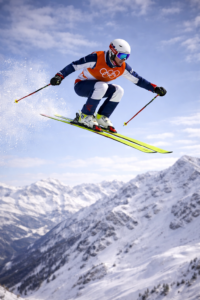
Zero.
Which meant the qualification bar was… technically open.
Most people with Edward’s poor eyesight and lack of training would look at ski jumping and think: “That looks dangerous. I should avoid that.”
Eddie looked at it and saw an opportunity.
This was less a strategic masterstroke and more a loophole discovered by sheer persistence and the desire to fulfill a lifelong dream.
Learning to Ski Jump (On a Budget That Barely Existed)
Ski jumping is one of the most technical and intimidating sports in the Winter Olympics. It requires:
-
Specialized hills
-
Precise timing
-
Aerodynamic positioning
-
Immense courage
Eddie had almost none of the infrastructure needed to learn properly. He trained primarily at Lake Placid, Germany, and anywhere he could find cheap access. Edwards funded himself by working odd jobs and sleeping on floors and in hostels to save an extra buck. Nearly all his equipment was either borrowed or secondhand and much of it was outdated and mismatched.
At times, Eddie’s equipment was so old and ill-fitting that it was borderline unsafe—even by ski jumping standards. Still, he didn’t let that stop him, finding ways to make it work. He once wore six pairs of socks in his boots because they were too big. Most people come to the Winter Olympics with the best of the best; Edwards came with whatever he could make work. And it did.
The Glasses, the Helmet, and the Look That Made Him Famous
Let’s talk about the look. We have to talk about the look.
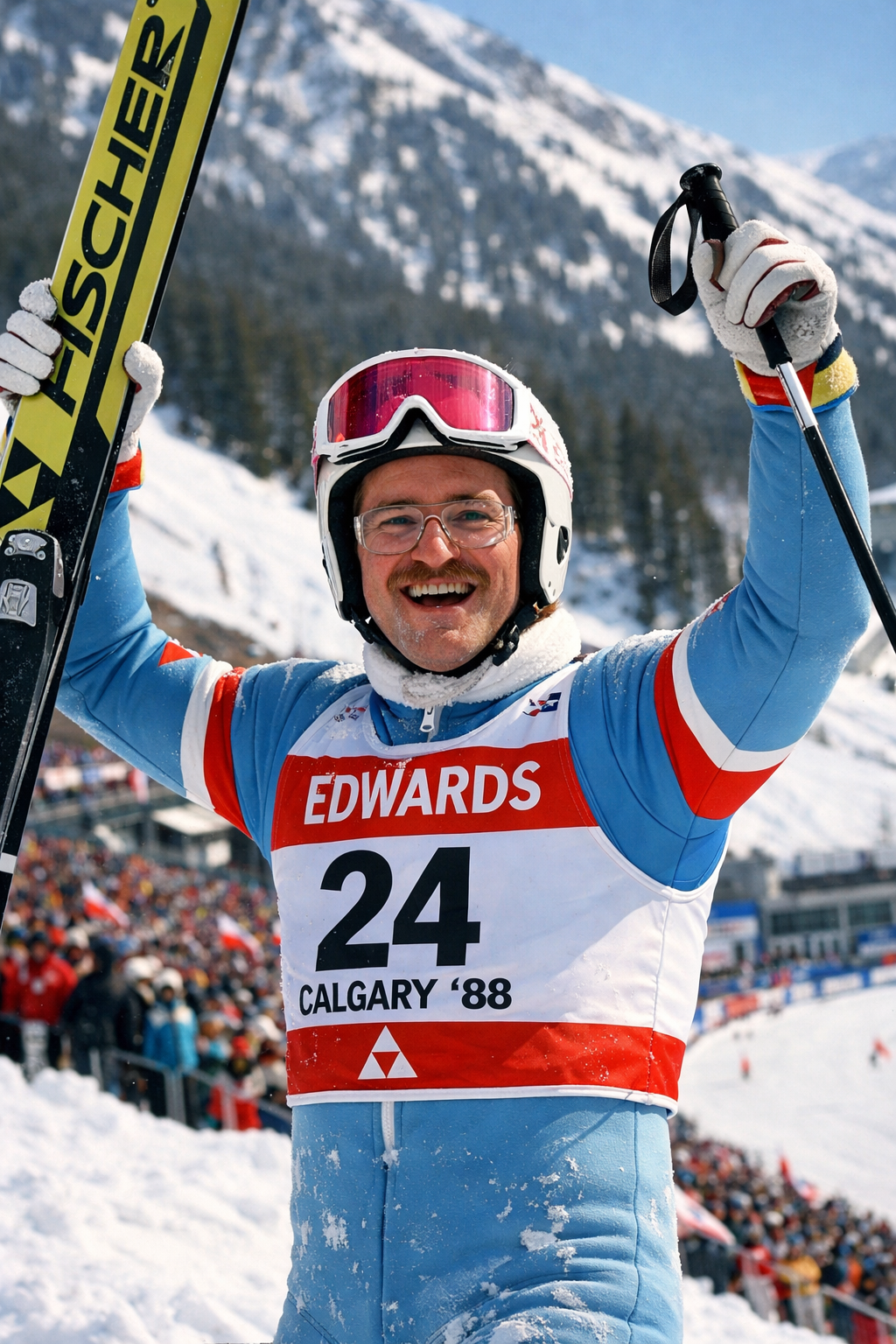
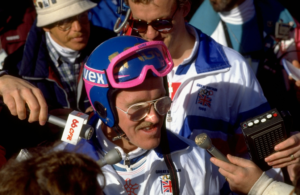 Eddie’s oversized glasses, strapped tightly to his face under his helmet, became iconic. They fogged up constantly. He couldn’t afford contact lenses designed for cold-weather sport, and corrective sports eyewear wasn’t exactly accessible at the time anyways.
From a technical standpoint, this could be disastrous: poor visibility affects balance, fogged lenses reduce depth perception, and ski jumping already has little margin for error. Still, from a branding standpoint?
Accidental perfection.
Eddie didn’t look like an Olympic athlete—and that’s exactly why people remembered him. His look was iconic and would become a easy DIY Halloween costume for kids for years to come.
How Eddie the Eagle Qualified for the Olympics
This is the part people often misunderstand. Eddie didn’t sneak into the Olympics, he didn’t cheat, and he didn’t get lucky. He met the qualification requirements.
At the time, Olympic ski jumping qualification rules were less restrictive. Eddie competed in enough international events, logged the necessary distances, and complied with the Olympic standards that existed then.
He wasn’t competitive with top-tier jumpers—but he wasn’t disqualified either.
And because Great Britain had no other ski jumpers, Eddie became their representative.
Just like that, a self-funded, self-trained, near-sighted plasterer from England was headed to the 1988 Winter Olympics in Calgary.
The 1988 Winter Olympics: Where Legends Are Born
Eddie competed in:
-
The 70-meter jump
-
The 90-meter jump
In both events, he finished last. Let’s be very clear: he was not anywhere close to winning. But that wasn’t what made his performance historic. He didn’t crash. He didn’t bail. He didn’t quit. His can-do attitude and indomitable spirit made him a worldwide phenomenon at a Winter Olympic Games that also featured the iconic Jamaican bobsled team.
In a sport where mistakes can mean serious injury, Eddie completed every jump with composure.
The crowd loved him.
The media loved him.
Other athletes—initially skeptical—came to respect him.
Because ski jumping can be absolutely terrifying, and Eddie showed up anyway.
Why Eddie the Eagle Became a Global Sensation
Eddie’s popularity exploded because he represented something rare in elite sports:
Pure participation without pretense.
He wasn’t pretending to be the best, selling dominance, or hiding his limitations. He was honest, enthusiastic, and visibly thrilled to be there. In an Olympics often dominated by national medal counts and hyper-polished athletes, Eddie felt human. That mattered.
The “Eddie the Eagle Rule” (And Why It Exists)
 After 1988, the International Olympic Committee updated qualification standards—informally known as the “Eddie the Eagle Rule.”
The goal was to prevent athletes with minimal competitiveness from qualifying solely due to lack of national representation. Was Eddie the reason for the rule? Indirectly, yes. Was he blamed? Not really. While leadership at the Olympic committee saw Eddie Edwards run and how it could be exploited in the future, his effort was generally met with acceptance and amusement. The rule wasn’t an indictment against him—it was an acknowledgment that the system needed tightening.
Eddie had played by the rules and the rules were adjusted as a result. That’s how sports evolve. And how Eddie Edwards became a permanent part of both sport and Olympic history.
Life After the Olympics
Eddie never competed in another Olympic Games, but his career didn’t end in Calgary. He became:
-
A motivational speaker
-
Media personality
-
Symbol of perseverance
Over the course of his life he gave countless speeches to youth, businesses, and athletes. He leaned into the role with humor and humility, never pretending to be more than he was and people loved him for it.
Then came the movie.
“Eddie the Eagle” (2016): Hollywood Gets Involved
In 2016, the film “Eddie the Eagle” was released, starring: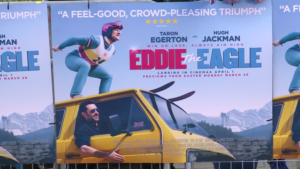
-
Taron Egerton as Eddie
-
Hugh Jackman as a fictionalized mentor
The movie took liberties—because Hollywood always does—but it preserved the core truths of Eddie’s Olympic attempt: It isn’t always about winning, it’s about being willing to try.
The film reintroduced Eddie to a new generation and cemented his place in Olympic folklore. If you love winter sports movies, check out the 7 Winter Sports Movies You Need to Watch This Winter.
Eddie the Eagle’s Legacy in Olympic History
Eddie’s legacy isn’t measured in medals. It’s measured in inspiration, accessibility, perspective, and impact. He reminded the world that the Olympic Games are about more than podiums. They’re about showing up, testing personal limits, national pride, international unity, and representing something bigger than yourself. For every gold medalist, there are thousands of athletes who train just as hard knowing they’ll never win.
Eddie gave those athletes a face. He gave every ordinary person a face at the Olympics that year.
Why Eddie the Eagle Will Always Be an Olympic Legend
Eddie Edwards didn’t redefine ski jumping technique, he didn’t push performance boundaries, he didn’t stand on a podium. He did something arguably harder. He reminded people why sports exist in the first place.
Not for dominance.
Nor for perfection.
But for courage.
In the history of inspiring Olympic athletes, Eddie the Eagle stands alone—not because he flew the farthest, but because he jumped anyway.
And sometimes, that’s the real victory.
Check out other inspiring stories and articles like this one here on Wild Child Sports: